Cited, public data sources
Satellite figures trace back to CelesTrak's NORAD catalog and exoplanet counts to the NASA Exoplanet Archive — not scraped estimates.
Professional space atlasGet the Data Pack — $9 →
Exorbit.space connects interactive WebGL space simulations with planet guides, mission dossiers, satellite snapshots, astronomy explainers, and research calculators for learners and builders.
Secure payment link by email · 7-day no-questions refund · instant download after payment.
Need team, bulk, or enterprise pricing? Contact Sales → or email admin@exorbit.space — we reply within 1 business day.
Ready to look up for real? See the beginner telescope we recommend — as an Amazon Associate we earn from qualifying purchases.
Pricing
Free
$0
3D space simulation, planet & moon guides, mission dossiers, and research tools — no account needed.
One-time
$9
Field Guide PDF + satellite & exoplanet CSV exports.
Plus updatesBest value
$19
Everything in the $9 pack, plus 12 months of quarterly catalog refreshes.
Need custom space data or a licensing quote?
Tell us what you're building — bespoke datasets, API access, content licensing, or partnerships — and we'll reply with pricing.
Get the free weekly space digest
Mission updates, new satellite launches, and black hole news every Friday — straight to your inbox.
One email a week. Unsubscribe anytime.
What's in the Data Pack
$9 one-time — get the Data Pack
Why trust Exorbit.space
No fabricated reviews here — just how the site actually sources data, handles refunds, and treats your privacy.
Satellite figures trace back to CelesTrak's NORAD catalog and exoplanet counts to the NASA Exoplanet Archive — not scraped estimates.
Not happy with the Data Pack? Email admin@exorbit.space within 7 days of purchase for a full refund.
The 3D simulation, planet guides, and research tools are free to use — no signup wall before you see the value.
Pageviews are counted with GoatCounter, a privacy-first analytics tool — no ad trackers, no cross-site profiling.
Explore by topic
These routes use focused page titles, headings, and internal links so search engines and visitors can understand the main Exorbit.space topics.
Open the interactive WebGL space simulator with solar-system scale, Milky Way context, satellites, constellations, and planet readouts.
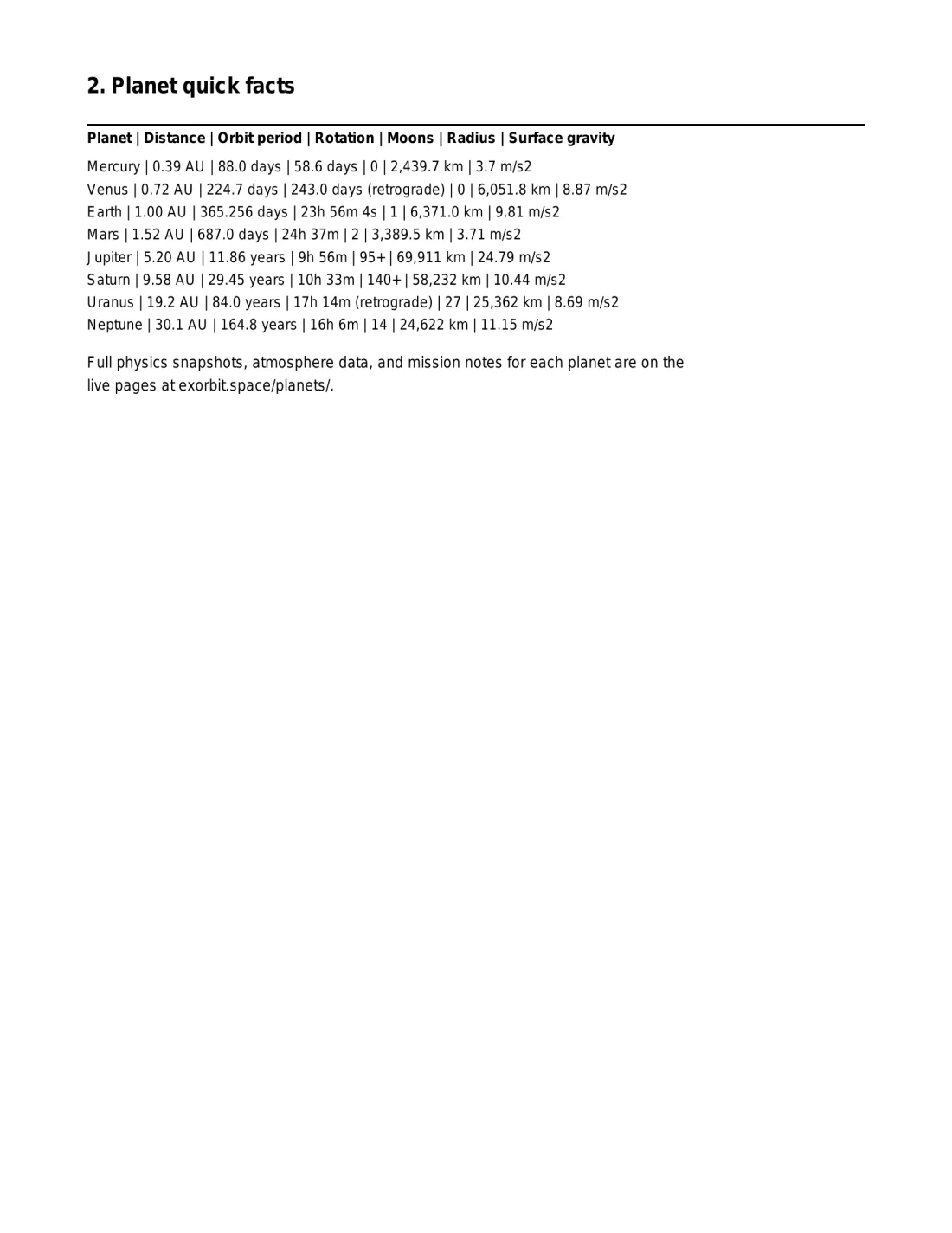
Study planets, orbital motion, heliocentric positions, planet facts, and connected field-guide pages.
Use orbit calculators, mechanics notes, WebGL labs, datasets, and model-verification references for astronomy and space technology.
Explore black holes, stellar systems, cosmic expansion, deep-space structures, telescopes, and observational context.
Read mission dossiers for spacecraft, rovers, telescopes, launch systems, agencies, and exploration hardware.
Run the ENSO probability simulation with Nino-3.4 anomaly, trade winds, thermocline tilt, rainfall shift, and NOAA CPC probability anchors.
Planet & Mission Field Guide PDF plus satellite and exoplanet catalog CSV exports, delivered by secure email payment link.
Mission Desks
WebGL model with current approximate planetary positions and clickable planet pages.
Dedicated pages for all eight planets with physics, missions, and exploration notes.
Separate simulations for Earth, Mars, Jupiter, Saturn, Uranus, Neptune, and dwarf-planet moon systems.
Sojourner through Perseverance, rover science goals, payloads, mobility, and sample return context.
Moon-to-Mars architecture, Orion, SLS, Gateway, HLS, surface systems, and mission sequence.
Telescope engineering, servicing history, science legacy, and deep-field discoveries.
Operational and historic launch systems across agencies and commercial providers.
Deep Research Areas
Alpha Centauri, exoplanets, galaxies, cosmic distance ladder, telescopes, Gaia, Hubble, Webb, NED.
Propulsion, GN&C, power, thermal, robotics, ECLSS, comms, science payloads, and autonomy.
Prospecting, extraction, beneficiation, ISRU, economics, law, and environmental limits.
NASA, ISRO, ESA, Roscosmos, CNSA, JAXA, and commercial ecosystems in context.
Current satellite catalog snapshots, live news cards, ephemeris vectors, and open data panels.
Calculators, dataset links, reading maps, unit converters, and mission-design references.
Specialist editorial personas for mission news, science review, launch tracking, mining, and agency intelligence.
Recommended resources
Everything on this site works from a screen, but the fastest way to fall in love with space is to look up. These are the beginner telescope and star chart we point newcomers to.
As an Amazon Associate we earn from qualifying purchases.
Mathematical model
This page does not introduce a standalone generated physics or engineering simulation. Any decorative background or static illustration is presentation only; mathematical claims must come from the cited equations, catalog values, or linked model-verification pages.
Decorative images, icons, and background effects on this page are not used as evidence for a scientific or engineering statement.
If the text gives a quantitative fact, it must be traceable to a data field, unit conversion, or equation on the relevant detailed page.
Interactive pages linked from here carry their own mathematical model sections with equations, assumptions, proof notes, and limitations.
Verification standard: the rendered object must be reproducible from stated equations, catalog parameters, or explicit geometric transforms. Visual reference images may inform presentation only; they are not the source of orbital positions, field vectors, accretion-disk gradients, timing, or engineering layout.
Limitations: browser scenes may use bounded scale, compressed distances, simplified two-body dynamics, schematic transfer curves, or educational approximations where full numerical ephemerides, CFD, finite-element models, or general-relativistic ray tracing are outside the page scope. Those simplifications are part of the model contract, not hidden image-based construction.